

The XAA (Cross-App Access) Debugger tests an MCP server and its authorization setup.
MCPJam acts as both:
- The identity provider, which signs the ID token and ID-JAG.
- The client/agent, which presents the ID-JAG and uses the access token.
Before You Run the Test
Trust MCPJam’s Identity Provider
The XAA Flow header shows three URLs:
Configure your authorization server with the values it requests. The Issuer URL identifies MCPJam’s test identity provider, the OpenID Config URL provides discovery metadata, and the JWKS URL provides the public signing keys.
Local and hosted issuers
If MCPJam is running locally and your authorization server is hosted in the cloud, turn on Use hosted issuer in the XAA Flow header. A cloud server cannot reach a local Issuer URL.
Other header controls
The header also has an Identity assertion (OIDC / SAML) toggle that sets the format MCPJam mints, covered under Identity assertion format. It also has a Run as control for choosing the simulated identity.Add Your MCP Server
Select Configure Server to Test (or Add Server), enter the MCP server name and URL, then choose how MCPJam identifies itself to the authorization server.Server Configuration
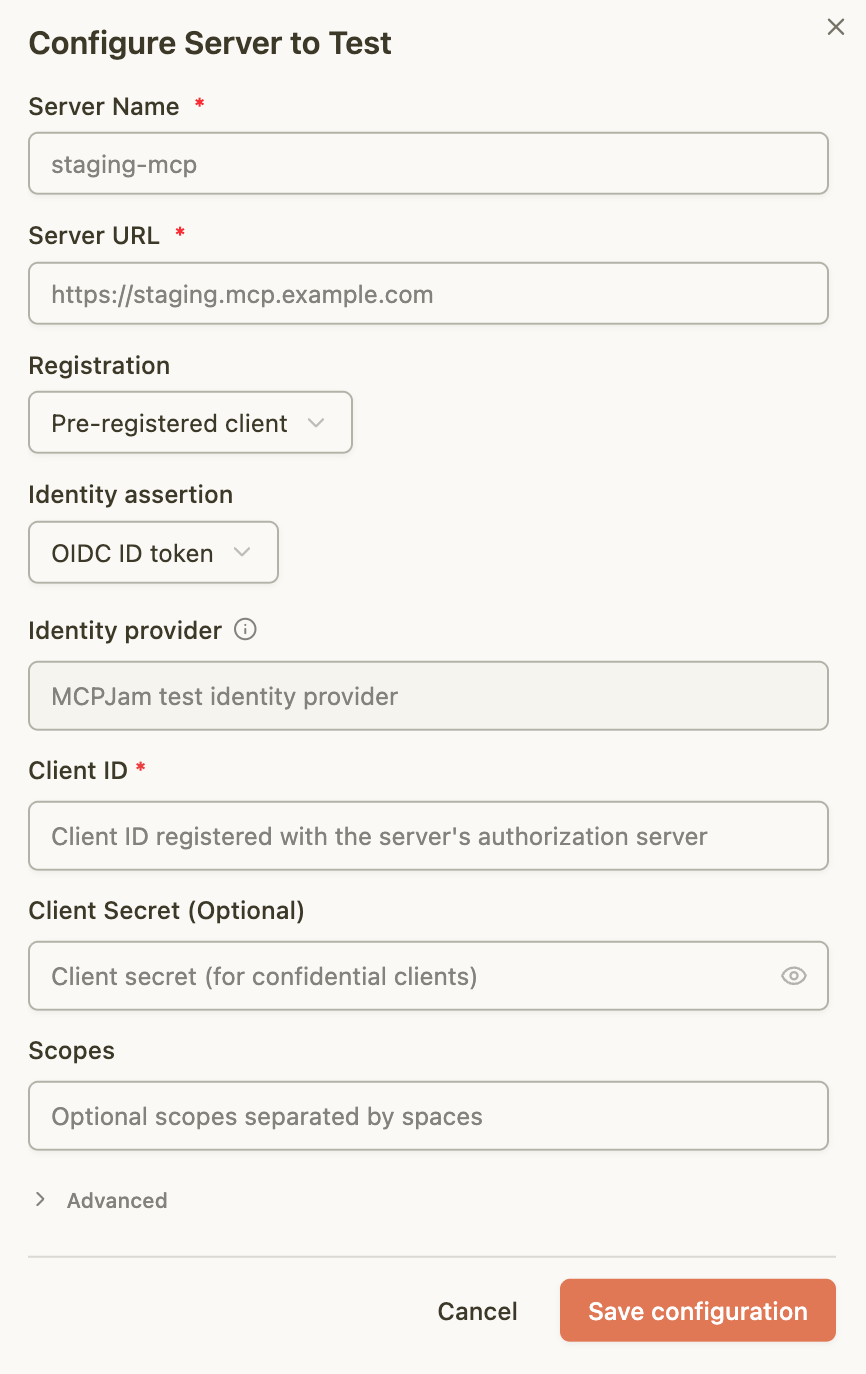
Registration Method
- Pre-registered client: Register MCPJam in your authorization server first, then enter the client ID and optional client secret it gives you.
- Client metadata URL (CIMD): MCPJam uses a client metadata URL as the
client ID. Your authorization server must advertise CIMD support. The
Client authentication control chooses whether MCPJam proves it owns that
identity:
- Public (no client auth): Your authorization server takes the metadata URL at face value. Nothing proves MCPJam owns that identity. This is the default.
- Confidential (private_key_jwt): MCPJam holds a private key and signs each token request with it, proving it owns the identity. Choose this when your authorization server requires a confidential client. In the hosted inspector, this option requires you to be signed in with an active organization; MCPJam probes for the capability automatically and blocks Start/Run with a clear message if the requirement is not met.
- Open dynamic registration (DCR): MCPJam registers a client during the test. Your authorization server must provide an open registration endpoint.
Identity assertion format
Choose the protocol MCPJam’s identity provider uses to authenticate users.- OIDC ID token: MCPJam mints an OIDC ID token as the identity assertion. This is the default.
- SAML assertion: MCPJam mints a signed SAML 2.0 assertion, and the ID-JAG
carries a
saml-nameidsubject identifier so a SAML-federated server can resolve the user.
Scopes
Enter optional permissions separated by spaces. MCPJam includes them when requesting the ID-JAG and access token.Advanced Settings
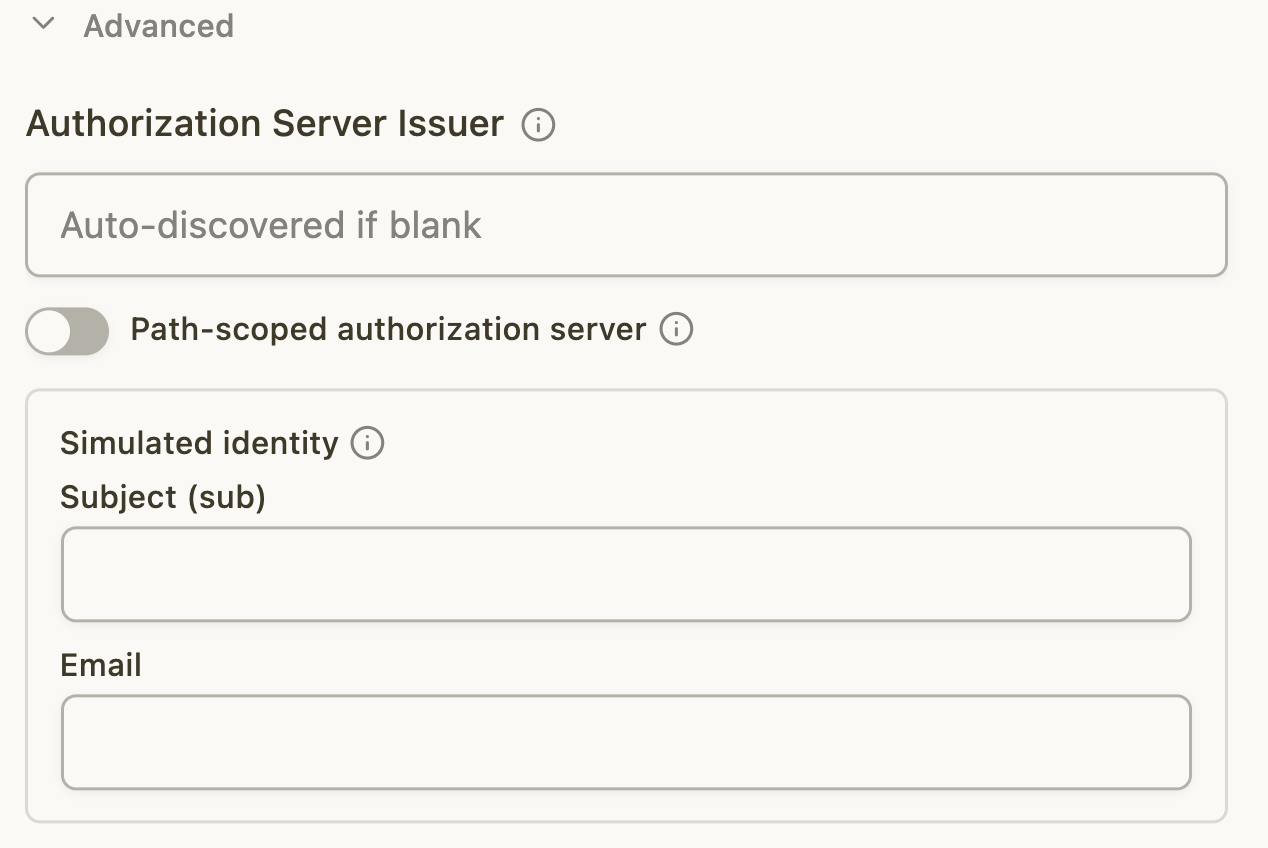
Authorization Server Issuer
Leave it blank to use the authorization server MCPJam discovers from the MCP server. Enter a URL to use a different authorization server.Path-scoped authorization server
Keep this off for normal RFC 8414 behavior. Turn it on only when the discovered URL and metadata issuer differ on the same origin.Simulated identity
Choose the user MCPJam puts in the ID token. Leave the fields blank to use a built-in demo user (user-12345 / [email protected]).
Inspect the ID-JAG
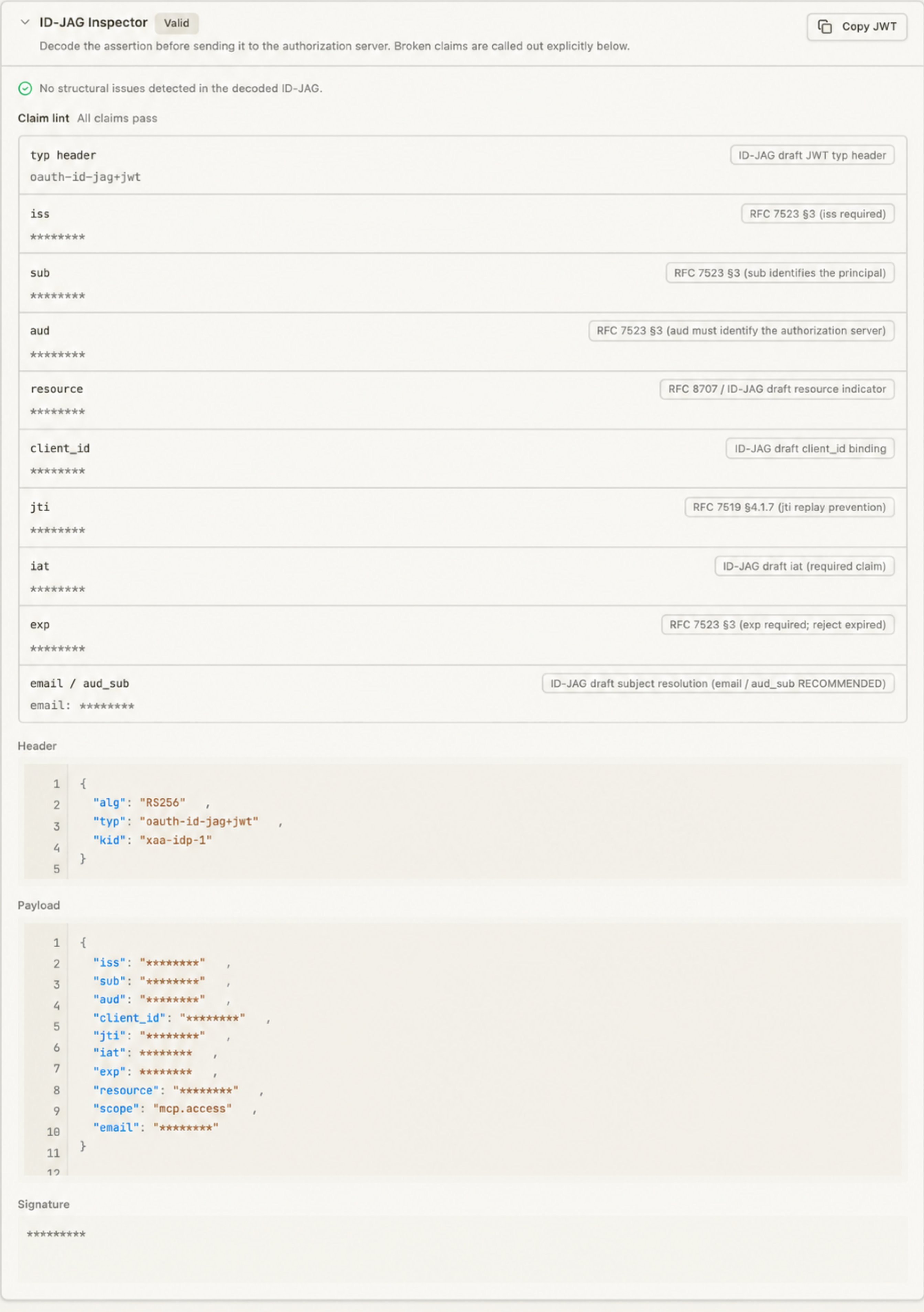
Header
The JWT header shows:alg: the signing algorithm.typ: the token type.kid: the signing key identifier.
Payload
The payload shows the values MCPJam puts into the ID-JAG:Signature
The inspector shows the signed JWT and provides Copy JWT for further inspection. The authorization server verifies the signature using MCPJam’s public signing keys.Negative Tests
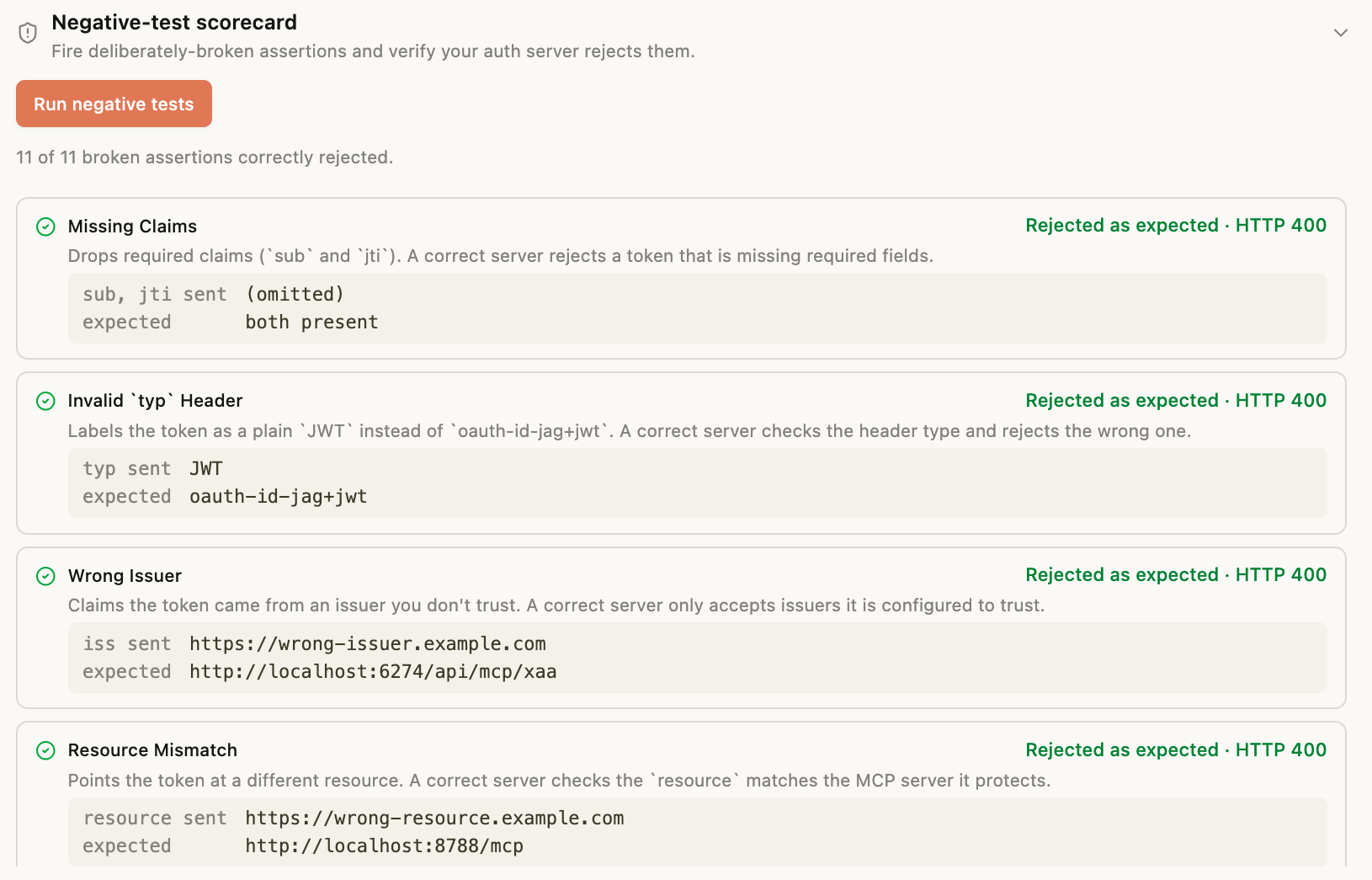
- Bad Signature
- Wrong Audience
- Expired
- Missing Claims
- Invalid
typHeader - Wrong Issuer
- Resource Mismatch
- Client ID Mismatch
- Unknown
kid
- Unknown Subject
- Scope Denial
The XAA Flow
The debugger shows the flow in the sequence diagram and logs each request and response:- Discover the MCP server and authorization server. MCPJam asks the MCP server which authorization server protects it, then reads the authorization server metadata.
- Resolve the client identity. MCPJam uses the pre-registered client, performs DCR, or uses its CIMD URL.
- Simulate sign-in at MCPJam’s identity provider. MCPJam issues a test ID token.
- Request an ID-JAG. MCPJam’s identity provider exchanges the ID token for an ID-JAG.
- Request an access token using the ID-JAG. MCPJam sends the ID-JAG to the authorization server’s token endpoint using the JWT-bearer grant.
- Call the MCP server. MCPJam sends the resulting access token to the MCP server.
Debugging Failures
The right panel shows each flow step, its request and response details, and any available token information. If a step fails, it also provides guidance for diagnosing the problem. This may include:- The authorization server does not advertise or accept the JWT-bearer grant.
- MCPJam’s issuer or signing keys are not trusted.
- The client identity is missing, unregistered, or not allowed to use the grant.
- The aud, resource, or client_id claim does not match the authorization server’s configuration.
- The authorization server issues a token, but the MCP server rejects it.